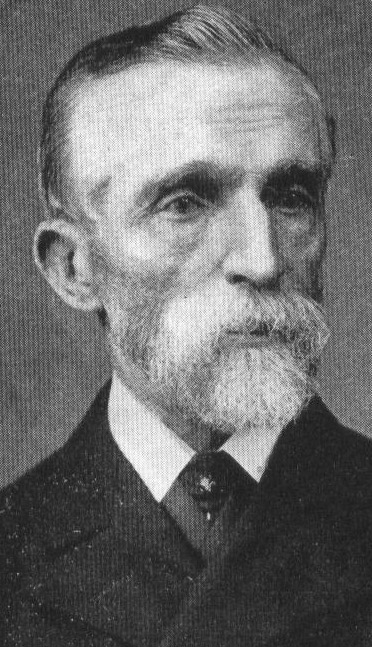
About John Ritchie Findlay
John Ritchie Findlay was the grandnephew of William and John Ritchie, two of the chief founders of the Scotsman newspaper. In 1841, at the age of 16, he joined the paper as a clerk and worked his way through the ranks, becoming proprietor in 1870. He married Susan Leslie, with whom he had three sons and seven daughters.
John Ritchie Findlay was not only successful in his journalistic endeavours; he was also a great patron of the arts and Scottish history, and after his death in 1898, it was remarked: “Edinburgh can scarcely have had a citizen of more truly public spirit”. In 1882, Findlay donated £10,000 to establish a gallery for the Society of Antiquities (of which he was secretary at the time) in Edinburgh’s New Town. The Society hired architect Dr Rowand Anderson and his assistant Sydney Mitchell (who built Number 3 Rothesay Terrace for Findlay as a family home), to build the Queen Street building, which later became the Scottish National Portrait Gallery.
The Portrait Gallery was not the only endeavour with which Findlay was linked: he was very keen that there should be provision for the formal education of artists, and as such, he was an active member of the committee that set up Edinburgh College of Art. A very conscientious and philanthropic man concerned with the health and well-being of the working classes, he served as president of the Association for the Medical Education of Women, founded the Edinburgh Association for Improving the Conditions of the Poor, campaigning for better housing, hygiene and rights for impoverished families in the city, and served as director of Edinburgh’s Royal Hospital for Sick Children. He is credited with persuading the University of Edinburgh to finally allow women to train as doctors and surgeons after the Edinburgh Seven debacle. Susan Leslie supported her husband and was herself very active in furthering their causes.
Findlay was very aware that the living conditions in Dean Village, overlooked by his Rothesay Terrace home were deplorable, and so, having purchased the land, he commissioned Sydney Mitchell to design and build model living accommodations for the working poor, named Wells Court. Findlay’s eldest son, also John Ritchie Findlay (later, Sir John Richie Findlay, 1st Baronet), who became chairman of the Scottish National Housing Company, was also involved in the building of Well Court, seen today with its distinctive reddish brick, clock tower and courtyard. This collaboration resulted in two- or three-bedroom flats, a central courtyard to operate as a communal drying green for people to hang their washing, and a community hall, with oriel windows and a clock tower. The Well Court flats were advanced for their time, featuring plumbing and internal sanitation facilities, and contemporary writing notes that it was very clear to see that the health of those living in Well Court was distinctly better than the health of those living in slums elsewhere in Edinburgh.
JRF’s love of art and entertaining guests is demonstrated throughout Number 3 Rothesay Terrace, particularly in the public rooms of the ground and first floors. From the delicately hand-carved wooden friezes and embellishments in the public rooms, to the detailed ceiling frescoes (one of which can still be seen in the Findlay Room on the first floor), Late Victorian ornamentation overwhelms the senses. The entry porch, originally enclosed by a pair of wrought iron gates of Italian design featuring delicately entwined leaves and flowers, was just the beginning of his guest’s experience. As Findlay himself remarked:
“It shows the value of such an object-lesson in art, for when first put up it was a treat to see the number of working people and others who came to admire it.”